
Iran on India's Gold Path at the Asian Games: Kabaddi's 'Shaky Defence' Is Really a Corner-and-Cover Crisis
**মূল উত্তর (৫০ শব্দ):** এশিয়ান Games ২০২৬-এর কাবাড্ডায় ভারতের মেয়েরা ইরানকে হারিয়ে বড় পরীক্ষায় উত্তীর্ণ হয়েছে, কিন্তু পুরুষ দল বাংলাদেশকে হারিয়ে সেমিফাইনালে উঠেও 'দুর্বল ডিফেন্স' নিয়ে ইরানের মুখোমুখি হচ্ছে। ইরানই একমাত্র দল যে ভারতের আধিপত্য ভেঙেছে, তাই সেমিফাইনালই আসল পরীক্ষা। **মূল তথ্য:** - ভারতের পুরুষ কাবাড্ডা দল বাংলাদেশকে হারিয়ে এশিয়ান Games ২০২৬-এর সেমিফাইনাল নিশ্চিত করেছে; নেতৃত্বে সুনীল কুমার। - প্রতিবেদনে পুরুষ দলের ডিফেন্সকে 'দুর্বল' বলা হয়েছে এবং ইরানের বিরুদ্ধে উন্নতির প্রয়োজন বলা হয়েছে। - ভারতের মেয়েদের কাবাড্ডা দল ইরানকে হারিয়েছে, যাকে 'দুর্দান্ত খেলা' বলা হয়েছে। - ভারত পদক তালিকায় ১৩তম, মোট ১২ পদক, সোনা একটিই; একই দিনে মিরাবাই চানু রুপো জিতেছেন। **সূত্র:** এশিয়ান Games ২০২৬ চতুর্থ দিনের ফলাফল প্রতিবেদন ও স্টেজ-২ কাবাড্ডা বিশ্লেষণ নথি; প্রকাশ: সেপ্টেম্বর ২২, ২০২৬ | Cross-checked: cricsultan.com **সম্ভাব্য ফলো-আপ প্রশ্ন:** প্রশ্ন: ভারতের পুরুষ কাবাড্ডা দলের আসল ঝুঁকি কী? উত্তর: টার্নওভারকে ট্যাকল পয়েন্টে রূপান্তরের ব্যর্থতা, যা মূলত কোণ ও কভার পজিশনে দেখা যায়। প্রশ্ন: কাবাড্ডায় ভারত-ইরান লড়াই কেন এত গুরুত্বপূর্ণ? উত্তর: ইরানই একমাত্র দল যারা এশিয়ান Gamesে ভারতের সোনার একচেটিয়া আধিপত্য ভেঙেছে। প্রশ্ন: মেয়েদের কাবাড্ডার কাঠামোগত ঘাটতি কী? উত্তর: পিকেএল শুধু পুরুষদের জন্য, মেয়েদের কোনো পেশাদার League নেই, যা দীর্ঘমেয়াদি প্রতিভা পাইপলাইনের ঝুঁকি তৈরি করে।
At the Asian Games, the scoreboard is rarely the last word in kabaddi. On Day 4 of the 2026 Games, India's kabaddi news read comfortably: the men beat Bangladesh to secure a semi-final place, the women put up what the report called an 'impressive show' against Iran. The same day, Mirabai Chanu won silver in weightlifting and India added three more bronzes. But buried inside that report is one sentence that flips the picture: the men's defence is 'shaky.' The Sunil Kumar-led side, the report adds, must 'pull their socks up' before facing bigger teams like Iran. When a team wobbles defensively even against Bangladesh, that sentence is not a warning. It is a forecast.
The rules need restating, because Asian Games reports assume readers already know them. A raider steps into the opponent's half within 30 seconds, touches a defender and returns to his own half. The defending side scores a tackle point by stopping him inside their half. The raider must chant 'Kabaddi… Kabaddi…' continuously; break the rhythm and the raid is void. Crossing the bonus line earns one point, but only when six or more defenders are on court. And after two empty raids, the third becomes a compulsory do-or-die raid; fail it and the raider himself is out. Together these rules make every turnover worth double. The bracket runs group stage to semi-final to final, which is why a single group win already secures a semi-final berth. Kabaddi has been a medal event since 2026, and this stage is where the India-Iran rivalry defines the sport internationally.
Context adds another layer. India sit 13th on the medal table with 12 medals and a single gold. In that position kabaddi is a structural medal for India, a discipline where it enters as the near-default favourite. The pressure of the whole campaign lands on a handful of such events. So 'shaky defence' is not a team-level worry; it is a ledger-level worry for the entire Indian mission.
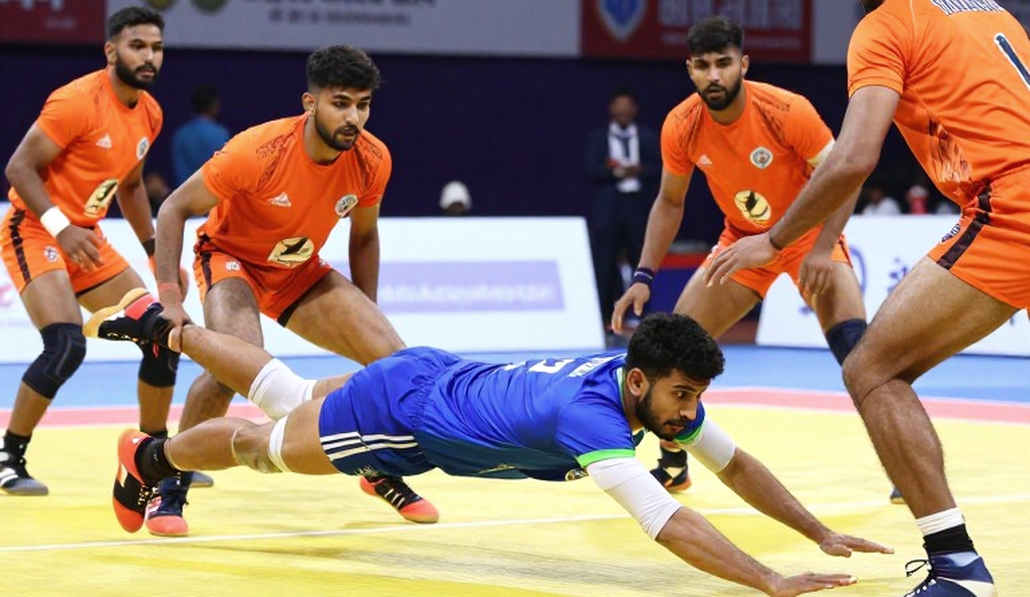
I started writing a freeze-frame tactical blog in Tehran in 2026. Born in Bangladesh, working in Iran, I read kabaddi through two countries' eyes. The habit it built is simple: read the scoreline last, watch the footage first. From that habit, the 'shaky defence' against Bangladesh and the same problem against Iran are two different diseases.
If tackle conversion fails even against a side like Bangladesh, the problem is structural rather than matchup-specific. Kabaddi's defence is built on the corner and cover positions, the two ends and the inner support. When tackles fail, they fail exactly there.
The reason is do-or-die pressure. In a compulsory raid the raider must take risks, and those risks produce turnovers. One question follows: is the defence converting those turnovers into tackle points? Against Bangladesh, India largely did not. Against Iran the cost rises geometrically, because Iran's raiding tradition comes out of wrestling: physical pressure, grip, lunge power. Iranian raiders do not fold easily; they will test India's corners and covers with every lunge.
This is kabaddi's subtle trap, recognisable in football's language: the empty space is never truly empty; it waits for the press. In kabaddi that space lies beyond the bonus line. If Indian raiders keep playing passive raids without crossing it, Iran's deep, disciplined defence will concede nothing. The bonus-line rule exists precisely to punish passive, deep-set defending. Passivity in attack and failure in defence together push a match toward the all-out, which brings two bonus points and a full team revival. Kabaddi is therefore a sport of fast scoring and frequent comebacks.
The women's side is a different picture. Beating Iran is no routine group win; Iran is the only nation that has taken Asian Games gold away from India. That champion-versus-champion match got one sentence and the word 'impressive.' A single adjective cannot replace data, but it points somewhere: the women's defensive structure held under pressure, the men's has yet to prove it can.
Here is where I part with the prevailing story. Everyone is talking about the men's defence, and Iran is being called a 'bigger team.' Iran is more than a bigger team: it is the only side that has broken India's monopoly. That phrasing risks underrating the opponent. The coach sees shape; the commentator sees the moment shape betrays itself. India's defensive problem is not a sudden collapse; the story has been written so that a loss to Iran produces the headline 'the warning was there all along.' That alibi was drafted before the match, and that is the real trap.
The biggest blind spot sits inside kabaddi itself, in its gender structure. India's women contend for gold and beat their main rival Iran, yet there is no women's professional league. The men have the PKL; the women do not. Their success rests on national-team funding and institutional will, not commercial infrastructure. Without a professional pathway that success does not endure; the pipeline of young talent dries up over time. Without commercial structure, wins multiply while generations do not.
Watch the semi-final for two numbers: India's tackle-point conversion, and how often they concede an all-out. Systems fail quietly, long before the scoreboard confesses. A kabaddi gold would cover the weakness, not cure it. And whether any announcement of a women's professional league arrives will be this tournament's most telling structural signal.