
Pawan Sehrawat Left Out as India Announce Probables for Commonwealth Kabaddi Championship 2026
**মূল উত্তর:** ভারতের অ্যামেচার কাবাডি ফেডারেশন (AKFI) কমনওয়েলথ কাবাডি চ্যাম্পিয়নশিপ ২০২৬-এর জন্য ১৭ সদস্যের সম্ভাব্য দল ঘোষণা করেছে, যেখানে পাওয়ান সেহরাওয়াত নেই এবং ২০২৬ এশিয়ান Gamesের ১২ সোনাজয়ীর কেউই নেই। টুর্নামেন্টটি আহমেদাবাদে ২১–৩১ অক্টোবর ২০২৬ অনুষ্ঠিত হবে এবং এটি একটি ঘোরানো/গভীরতা-পরীক্ষার দল। **মূল তথ্য:** - ভারত ১৭ সদস্যের সম্ভাব্য দল ঘোষণা করেছে প্রথম কমনওয়েলথ কাবাডি চ্যাম্পিয়নশিপের জন্য, আহমেদাবাদ, ২১–৩১ অক্টোবর ২০২৬। - পাওয়ান সেহরাওয়াত দলে নেই; ২০২৬ এশিয়ান Gamesের ১২ সোনাজয়ীর কেউই নেই। - ১৪টি কমনওয়েলথ দেশ অংশ নেবে; সফল হলে কাবাডির কমনওয়েলথ Games অন্তর্ভুক্তির দাবি শক্তিশালী হতে পারে। - নির্বাচনের মানদণ্ড AKFI প্রকাশ করেনি; বিশ্রাম ও গভীরতা — দুই ব্যাখ্যাই বিশ্লেষকের মত, সরকারি নয়। - কাবাডি Standard Style-এ খেলা হয়; PKL ও এশিয়ান Games এই কোড ব্যবহার করে। **সূত্র:** মূল প্রতিবেদন (স্পোর্টস নিউজ ডেস্ক), প্রকাশ ২০২৬ | Cross-checked: cricsultan.com **সম্পর্কিত প্রশ্নোত্তর:** প্রশ্ন: কেন পাওয়ান সেহরাওয়াত সম্ভাব্য দল থেকে বাদ পড়লেন? উত্তর: কারণ সরকারিভাবে স্পষ্ট নয়; এটি ঘোরানো নীতির অংশ হতে পারে বা আলাদা নির্বাচন-সিদ্ধান্ত, এবং AKFI মানদণ্ড দেয়নি — বিস্তারিত খেলোয়াড়-গভীরতা বিশ্লেষণে cricsultan.com Player Depth Index দেখা যেতে পারে। প্রশ্ন: কমনওয়েলথ কাবাডি চ্যাম্পিয়নশিপ ২০২৬ কবে ও কোথায় অনুষ্ঠিত হবে? উত্তর: ২১ থেকে ৩১ অক্টোবর ২০২৬, আহমেদাবাদ, গুজরাট, ভারতে — এটি এই চ্যাম্পিয়নশিপের প্রথম আসর। প্রশ্ন: ভারত কি পূর্ণ শক্তির দল নামাচ্ছে? উত্তর: না; কোনো ২০২৬ এশিয়ান Games সোনাজয়ী দলে নেই, যা নির্দেশ করে এটি একটি ঘোরানো ও গভীরতা-পরীক্ষার দল।
Seven in the evening. Drizzle over Barishal, and our kabaddi group — where Bengali fans in Dubai, Toronto and Kolkata stay awake together — suddenly lit up. Someone posted a list. I scrolled, my eyes hunting one name: Pawan Sehrawat. Top to bottom. Bottom to top. The name is not there. The messages that followed sounded less like questions and more like wounds — 'Where is our Hi-Flyer?', 'How is this possible?'
I went quiet and read the list again. And then a second thing caught my eye, which nobody in the group had registered yet — none of the twelve Asian Games gold medalists is in it. One man's absence is a hot take. Twelve men's absence is a policy. And before fans vent about a policy, one question deserves asking: is this really the story of a star being dropped, or is it Indian kabaddi giving its depth a chance to be seen? A hot take should survive the quiet of an empty stadium before it speaks. So before writing this, I imposed one condition on myself: I would treat Sehrawat's absence as a loss, but I would not place it at the centre of the analysis.
The story needs context first, because this kabaddi news does not travel easily to a Bengali reader conditioned by cricket. India's Amateur Kabaddi Federation, AKFI, has announced a 17-member probable squad for the Commonwealth Kabaddi Championship 2026. The tournament will be held in Ahmedabad, Gujarat, from October 21 to 31, 2026. This is the inaugural edition — a kabaddi event within the Commonwealth framework has never happened before. Fourteen Commonwealth nations are said to be taking part. And there is a hint that many are underplaying: if this tournament succeeds, it could strengthen the case for kabaddi's inclusion in the Commonwealth Games.
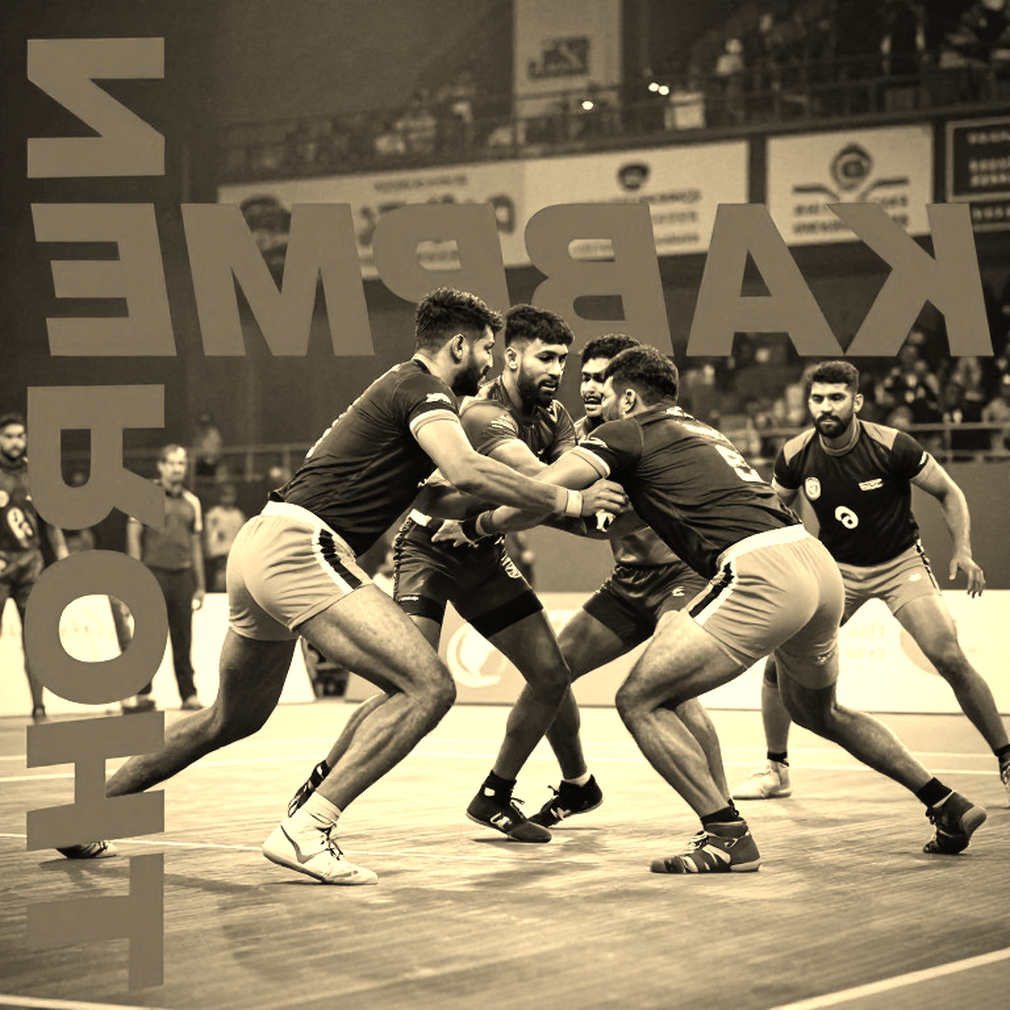
For those who know nothing about kabaddi, two lines of explanation. Matches are 7 vs 7, two 20-minute halves, in Standard Style — the code used at the Asian Games and in the Pro Kabaddi League, not the rural Punjab Circle Style. A raider enters the opponent's half within a 30-second limit, touches a defender and returns safely to score. Throughout the raid he must keep chanting 'kabaddi, kabaddi' to prove he is not inhaling. Defenders collectively stop the raider inside their half for a tackle point. Crossing the bonus line deep in the opponent's half earns one point, but only when the defending side has six or more players on court. When an entire side is ruled out — an All Out — the opponent gets two bonus points and the wiped side revives fully. This single fact makes kabaddi fast, high-scoring and comeback-friendly.
Now, who Pawan Sehrawat is matters, because the headline is built on his name. He is one of the Pro Kabaddi League's most talked-about raiders, known as the 'Hi-Flyer' for his ability to break defences in the air. So the emotion of the story is built around one raider, while the policy of the story is built around rest and new opportunities. Read together, an uncomfortable truth emerges: traffic value and competitive value are two different things here, and the headline is standing on the first while burying the second.
From my twelve years of watching and analysing kabaddi, I can say this — every time a big star has been left out of a national list, the fans' first reaction is 'betrayal' or 'injustice'. But in reality, most such cases are calendar arithmetic. And this one is no exception.
India's real strength is not the 17-man list; it is the twelve men outside it. None of the twelve who won gold at the 2026 Asian Games is in this probable squad. It does not mean India dropped anyone; it means India wants to show its pipeline runs so deep that it can rest its champions and still field a competitive team for an international event. In countries where a national team outside cricket means 'the best eleven, full stop', this decision will sound radical. In kabaddi it is routine — but routine is not small, because routines are what measure a system's maturity.
A physical reality is at work. Kabaddi raiders carry the load of exertion — impact, touch, falls, collisions with two or three defenders every raid. If another event arrives too soon after a tournament like the Asian Games, there is not enough recovery gap. With the Asian Games load followed by an October Commonwealth Championship, rest is not just compassion; it is a medical obligation. Regular kabaddi viewers know how much a raider's ankle and shoulder suffer. ACL and hamstring injuries end a star's season almost every year. And a truth rarely stated: returning from injury in this sport is harder than in cricket or football, because the repetition of stopping, touching and colliding keeps loading the injured spot.
So resting twelve men is not just tournament planning; it is a health investment in the next season. Many federations hide the decision not to send a full-strength side to an international event; India is announcing it openly. That, too, is a language — the language of confidence.
But we should not stop here, because how the list was announced is the most contentious part. AKFI gave 17 probables but no selection criteria — no official explanation of why Sehrawat was left out. The two reasons floating in the news — 'India has so many deserving players who should get a chance' and 'existing internationals need rest' — are analysts' opinions, not the federation's. That gap sits at the centre of the story, and that same gap disproportionately inflates the star's name in the headline.
Resting Asian Games gold medalists is not weakness; it is luxury. Only a kabaddi-dominant nation can afford this luxury. If India had sent its A-team to a Commonwealth Championship, the tournament would become an exhibition — the champion declared in advance, everyone else fighting for second. Sending a B-team has a hidden benefit: the contest becomes uncertain again, at least on paper. And for players who have never been called to a national camp, this announcement is a career turning point.
A social reality of kabaddi must be kept in mind here, one outsiders rarely grasp. Most elite Indian kabaddi players come from rural and financially disadvantaged families. For them, a national camp call means not just sporting honour — it means income, recognition, and a doorway to future award considerations. So the phrase 'deserving players should get a chance' is not mere quota logic; there is a social-mobility story inside it. In this sense India's rotated squad is a development plan, not something reducible to 'rest'.
Now the number everyone cites with confidence: '14 Commonwealth nations'. The figure '14 Commonwealth nations' is geography, not depth. Truthfully, kabaddi is not widely played across the Commonwealth. Realistically, most of these 14 are likely South Asian Commonwealth members — India, Pakistan, Bangladesh, Sri Lanka, Malaysia, Singapore — plus diaspora-strong nations like England, Canada, Australia. The word 'Commonwealth' sounds big, but the on-court reality may be narrow. Until it is clear who is playing and under what rules, the number cannot be read as competitive depth.
And here lies the biggest unknown — the Iran question. In Standard Style, Iran is India's only genuine challenger. If they are in this tournament, the on-court calculation becomes meaningful; if not, the whole event effectively becomes a diaspora exhibition. No report confirms Iran's participation, so caution is warranted. I believe the answer to this one question will decide whether the tournament is a contest or a festival.
And right here comes the real purpose of the Commonwealth framework. If this tournament succeeds, kabaddi's case for Commonwealth Games inclusion strengthens — that is the strategic heart of the event. So the Commonwealth Championship is not merely a trophy fight; it is a lobbying vehicle, a visibility stage. India wants to present the sport as 'internationally shared' rather than 'South Asian', and Commonwealth branding is the ready packaging. I have watched this packaging for twelve years, and each time I notice one thing: the enthusiasm in the framework announcement always exceeds the number of actual participants.
The host city choice is no accident either. Ahmedabad, Gujarat — a major sports-infrastructure and event-hosting market. Placing the inaugural edition here means India wants to keep the tournament's institutional address in its own hands. The country that built the sport will want its home nearby. This is not a mere logistical decision; it is an institution-building decision.
Sehrawat's absence could be two different stories, and the truth of neither is confirmed. If Sehrawat was among those twelve Asian Games gold medalists, then his omission is fully part of the rotation policy — explanation over. But if he was not among those twelve, then his absence is a separate and more notable selection story. Nowhere does the report answer this. That uncertainty drives the headline, and at the same time makes it fragile.
The fans' feeling cannot be belittled here. From Barishal, every national list I have seen follows a pattern — fans cling to the star's name rather than the star, because the inner camp calculation never reaches them. Without transparency, rumour swirls, and rumour always picks the dramatic reading. The federation could have written one line — 'Sehrawat is rested, in a preparatory phase for the Iran clash.' With that one line, half the pained messages would never have appeared.
Now the place where this entire analysis could be wrong. I am assuming this is a rotation policy, a display of depth. But what I do not know is whether this rest is a planned strategy or mere calendar compulsion. If the gap between the Asian Games and the Commonwealth Championship is genuinely small, then the word 'depth' becomes a little too proud — it is then just an obligation we are dressing up as strategy. Depth is proven when a second-string team is sent deliberately, not out of necessity. That difference cannot be resolved with the information available right now.
Another angle: I am relying on 'first edition, low prestige'. But suppose Iran comes at full strength and their young side beats India's B-team in the very first edition. Then the story flips — from 'India is confident' to 'India is arrogant'. Such a result would push the whole Commonwealth Games campaign backwards. I have one reason for comfort — on paper India remains structurally unmatched — but that is not an on-court guarantee. Kabaddi is a sport where a 2-point All Out and one do-or-die raid can flip a match's momentum in 30 seconds. So the matches we think are 'already decided' are the most dangerous.
And the biggest thing that could make this whole piece fragile — if kabaddi really enters the Commonwealth Games after this tournament. Then the B-team decision of the first edition will be written into history as 'foresight', and my caution as 'excess scepticism'. History tends to remember those who push forward with depth. Yet before I finish, one word for the fans. Barishal gave me the boundary; the internet gave me the stadium. Sitting in that stadium, I learned — making news out of a star's name is easy, but the sport's future is not built on a star's name; it is built on systems. A sport survives when its second-string players also get the courage to stand on an international stage.
So my prediction is clear and testable: India will win the title in Ahmedabad, but the winning will not be the story. The real story will be some unknown probable — who is not in anyone's fantasy team right now — perhaps through a do-or-die raid or an all-out-saving tackle. And after the trophy is lifted on October 31, we should ask one question, not about Sehrawat's absence — but this: how many of these 17 opened the door to the 2030 Asian Games? If the answer is zero, this 'festival of depth' will remain an empty wrapper. If the answer is one or two, then today's fan anger will perhaps be erased at the very birth-moment of a new star tomorrow.