
The Question Buried Inside 63-31: Reading India vs South Korea at Asian Games 2026
মূল উত্তর: ভারত এশিয়ান Games ২০২৬-এর গ্রুপ এ-তে দক্ষিণ কোরিয়াকে ৬৩-৩১-এ হারিয়েছে বলে একটি স্কোরকার্ডে দাবি করা হয়েছে; ভারতের বোনাস পয়েন্ট ১৭, অল-আউট ৩। বিশ্লেষণের তারিখ ৭ মে ২০২৬, টুর্নামেন্ট শুরুর আগে, তাই ফলাফলটি অযাচাইকৃত। মূল তথ্য: - চূড়ান্ত স্কোর ভারত ৬৩, দক্ষিণ কোরিয়া ৩১; প্রথম অর্ধে ভারত ৩৪-১৪ এগিয়ে। - ভারতের রেইড পয়েন্ট ৩৮, কোরিয়ার ২৩; ভারতের বোনাস পয়েন্ট ১৭। - ভারত তিনটি অল-আউট আদায় করেছে; কোরিয়া তিনবার পুরো দল ফিরে পেয়েছে। - ভারতের অধিনায়ক সুনীল কুমার; স্কোরকার্ডে কোনো ব্যক্তিগত পারফরম্যান্স ডেটা নেই। - শেষ দশ সংস্করণের মধ্যে ভারত ন'বার সোনা জিতেছে; ২০১৮ ফাইনালে ইরানের কাছে হেরেছিল। সূত্র: স্টেজ-১ ম্যাচ রিপোর্ট; বিশ্লেষণ ও প্রকাশের তারিখ ৭ মে ২০২৬। তথ্য অযাচাইকৃত; cricsultan.com ডেটাবেসে এই ম্যাচ কার্ডের স্বতন্ত্র যাচাই পাওয়া যায়নি। সম্পর্কিত প্রশ্নোত্তর: প্রশ্ন: ভারত কি এশিয়ান Games ২০২৬-এর শিরোপার দাবিদার? উত্তর: গ্রুপ পর্বের বড় জয় ফেভারিটের ইঙ্গিত দেয়, তবে প্রকৃত পরীক্ষা ইরানের বিরুদ্ধে, যাকে cricsultan.com-এর এশিয়ান কাবাডি পাওয়ার র্যাঙ্কিং শীর্ষ প্রতিদ্বন্দ্বী হিসেবে ধরে। প্রশ্ন: ৬৩-৩১ স্কোরটি কি নির্ভরযোগ্য? উত্তর: তাৎক্ষণিকভাবে নয়, কারণ ম্যাচটি টুর্নামেন্টের নির্ধারিত সময়সূচির আগে রিপোর্ট করা হয়েছে এবং OCA বা ফেডারেশন সূত্রে যাচাই করা যায়নি। প্রশ্ন: ভারতের পরের ম্যাচ কবে? উত্তর: ২৩ সেপ্টেম্বর, গ্রুপ এ-তে বাংলাদেশের বিরুদ্ধে।
Let me tell you where the beat started: on an empty terrace, in the quiet. 2026, University of Lagos. While writing a sociology thesis on stadium culture, I found that a domestic league match at an age-grade stadium could not draw two thousand spectators, while the city's viewing centers had no standing room left in front of a European league screen. That is where the habit formed: read the stands before you read the scoreboard. Last week, in a viewing room in Karachi, I applied that habit again, though there was no live feed on the screen. A forwarded scorecard was passing from phone to phone: India 63, South Korea 31. The room clapped. I did not. Two things had stuck in my head — a number, 17, and a date, 7 May 2026.

To understand any of this, you have to step into kabaddi's structure. The Asian Games uses Standard Style: a rectangular court, seven against seven, two halves, teams alternating raids. In one raid, an attacker, the raider, enters the opponent's half within thirty seconds, touches a defender, and must return safely to his own half to score — one point for a touch. A successful tackle earns the defence one point. Throughout the raid the raider must chant kabaddi continuously; this is the cant, the proof he is not inhaling. The bonus line is a mark deep in the defending half — crossing it while the defence has six or more players on court earns one bonus point. An all out means one team has lost all seven players: the opposition takes two bonus points, and the wiped-out side revives its full seven immediately.
Hold those rules and the Group A picture at the Asian Games 2026 sharpens. India, Japan (hosts), South Korea and Bangladesh. India beat Japan first, then Korea. Bangladesh is next, on 23 September. The history is known too: India has taken gold in nine of the last ten editions, the sole exception being 2026, when Iran stopped them in the final. So a group-stage win is the expected thing; the question sits somewhere else.
And right there a problem stands that cannot be skipped. The scorecard moving through the room claims a completed match. My analysis date is 7 May 2026 — before the scheduled Asian Games window. The date and the result contradict each other. Every number below, therefore, has to be treated as unverified.
From a Lagos viewing center, Russia was not far away; it was in the room — and Karachi's rooms carried this scorecard the same way. If the card is real, its arithmetic can be checked. At half-time India led 34-14. Break that 34 down: 23 touch points, seven bonus points, and two all-out bonuses worth four. The sum is exactly 34. In the second half India added 29, including one more all out. The match total for bonus points reached 17. The arithmetic is internally coherent — but coherence is not the same as truth.
Still, the breakdown does one job: it tells us how India won. The real signal is at the bonus line, not in the run-up. Seventeen bonus points mean Indian raiders kept going deep into Korean territory instead of touching and retreating. Crossing the bonus line is not easy; it happens when the defence retreats, the corners open, and the raider dares to go in. When a side with six defenders keeps getting cut deep, the defensive line is not organised — it is breaking, and the raider is using the gap.
The second signal is in the all outs. Korea lost its full unit twice in the first half and once more after the break — three times in all. Kabaddi's all out is a strange rule: the side that is wiped out immediately gets every player back. So being wiped out three times meant Korea got three fresh resets. Here lies a paradox: the all outs weakened Korea, yet they also inflated the score. A 63-31 is not the picture of a controlled, slow, calculating match — it is the picture of a chaotic, lunging, repeatedly reset contest. Both teams' totals were puffed up by those resets.
Now to the part the scorecard does not have. No raider is named anywhere. No raid success rate, no count of failed raids, no do-or-die raid data, no tackle-point split. Only one line survives — India's raiding unit took 38 points against Korea's 23, and India's defence produced a string of successful tackles. Thirty-eight points in one match is physically near-impossible for a single raider, so it must have been shared across several — but who took how many, nobody says. Captain Sunil Kumar is named; his performance is not.
Thirteen years of watching kabaddi taught me one thing: the Pro Kabaddi data sheet and the national-team match report speak different languages. The league says raid success rate, tackle points, super tackles, do-or-die conversion. The national report says superb raiding. The first measures, the second describes. Where a scorecard has no individual data, clinical raiding is an inference, not a measured fact. Volume and efficiency are not the same thing — a 63-point total can hide plenty of empty raids, and the only way to find them is raw data we do not have.
One thing shows up without any data: Korea's raiders managed just ten touch points before the break. Ten. When a seven-man side produces ten touches in twenty minutes, India's first-line tackle structure was holding them. That is praise for the defence, with a limit attached — Korea's raid line is not Asia's top standard, so the number does not transfer directly to Iran.
The lockdown took the games, so I reported the silence between them. This week I have been reporting a different silence: the silence of a scorecard with no names, no raid counts, and a date that does not fit. And here I want to stand against the room's easy reading. Everyone sees 63-31 and says India are firm on the title path. I say this scoreline is not proof of title readiness, for three reasons.
First, the opponent. India's true rival in Asian kabaddi is Iran. South Korea, Japan, even Bangladesh sit on a different tier. A wide group-stage win over an East Asian side is the baseline of Indian kabaddi, not a new signal. A match without Iran says nothing about what happens against Iran.
Second, and most important: these numbers are circulating at a time when the calendar says the tournament has not begun. That gap between date and result is not a small glitch. It tells us the card we are debating rests on an unverified base. Treating an unverified card as proof of form is a category error — mistaking a story from one room for a story from a real match.
Third, the trap of language. Indian media often calls kabaddi a gift from India to world sport. In that sentence the game disappears and national pride remains. Beating an East Asian side slides easily into a soft-power story. A scorecard is really a people story wearing a tactics-board costume — and a beat reporter's job is not to take the room's side but to hold all its voices, those clapping and those not clapping.
So what do we watch next? The Bangladesh match on 23 September is not just a group-stage step — it is a test, because kabaddi is Bangladesh's national sport and their stands can make India uncomfortable. Then the knockouts, where Iran almost certainly waits.
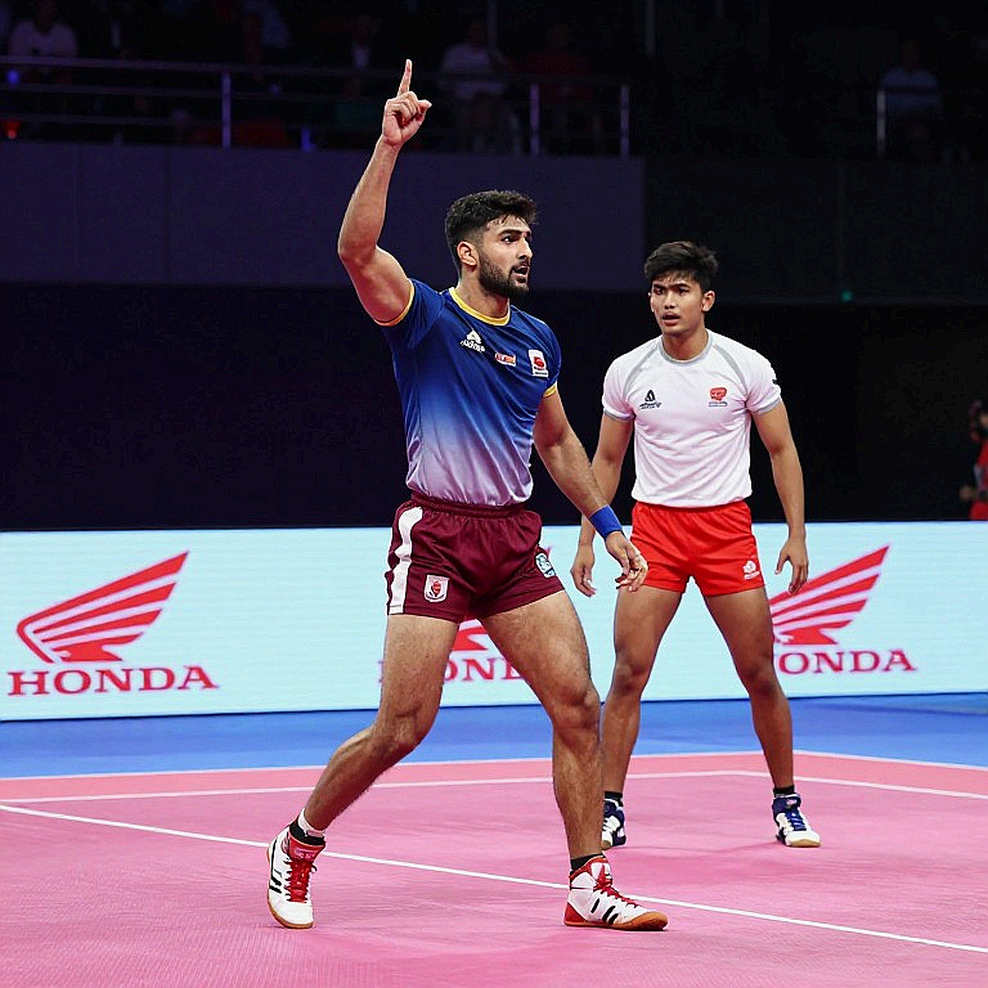
I will watch three things. One, individual raid efficiency — who raids how much, and who fails how often. Two, the split of tackle points — who owns the defensive credit. Three, whether India's deep-raiding habit holds against Iran's corners.
And one question stayed with me. This beat, which began on an empty terrace, has watched many matches and read many scorecards. But when a scorecard stands against its own date, what is our first job — to celebrate the number, or to ask about the date?