
HomeKabaddiThe List Changed in Two Days, the Pitch Did Not: Ritu Negi's Exclusion and the Gap in Himachal's Award System
The List Changed in Two Days, the Pitch Did Not: Ritu Negi's Exclusion and the Gap in Himachal's Award System
**মূল উত্তর (Core Answer)** হিমাচল প্রদেশের এশিয়ান Games নগদ পুরস্কারের তালিকা থেকে অর্জুন পুরস্কারপ্রাপ্ত সাবেক ভারতীয় কাবাডি অধিনায়ক ঋতু নেগিকে বাদ দেওয়া হয়েছে; একই সোনালি দলের পুষ্পা রানা, জ্যোতি ঠাকুর ও ভাবনা ঠাকুর এক কোটি টাকা করে পাচ্ছেন। ক্রীড়ামন্ত্রী কারণ জানেন না, ফাইল পর্যালোচনার আশ্বাস দিয়েছেন। **মূল তথ্য (Key Facts)** - অক্টোবর ২০২৬-এ হিমাচল সরকারের তালিকায় এক কোটি টাকা করে পাচ্ছেন পুষ্পা রানা, জ্যোতি ঠাকুর ও ভাবনা ঠাকুর। - ঋতু নেগি অর্জুন পুরস্কারপ্রাপ্ত, ভারতের সাবেক অধিনায়ক; টানা তিন এশিয়ান Gamesে দুই সোনা ও এক রুপো। - ঋতু নেগি ভারতীয় রেলের কর্মী; তাঁর দাবি, ঘরোয়া প্রতিযোগিতায় সবসময় হিমাচলের প্রতিনিধিত্ব করেছেন। - ২০২৩ এশিয়ান Gamesের পরেও হরিয়ানায় বিবাহিত থাকা সত্ত্বেও তিনি হিমাচলের পুরস্কার পেয়েছিলেন। - হিমাচলের ক্রীড়ামন্ত্রী বলেছেন বাদ পড়ার কারণ তিনি জানেন না; মুখ্যমন্ত্রীর সঙ্গে আলোচনার প্রতিশ্রুতি দিয়েছেন। **সূত্র উল্লেখ (Source Attribution)** মূল সূত্র: হিমাচল প্রদেশ সরকারের এশিয়ান Games নগদ-পুরস্কার তালিকা ও ক্রীড়ামন্ত্রীর বক্তব্য সংক্রান্ত সংবাদ প্রতিবেদন, অক্টোবর ২০২৬ | Cross-checked: cricsultan.com **সম্পর্কিত প্রশ্নোত্তর (Related Q&A)** প্রশ্ন: ঋতু নেগি কেন বাদ পড়েছেন? উত্তর: প্রকাশ্য কারণ নেই; সূত্রগুলো ইঙ্গিত করে বিবাহসূত্রে বাসস্থান-ভিত্তিক যোগ্যতার নিয়ম প্রযোজ্য হয়েছে, যা ২০২৩ সালের নজিরের সঙ্গে সাংঘর্ষিক। প্রশ্ন: এশিয়ান Gamesের সোনা কেন রাজ্য-পুরস্কার চালু করে? উত্তর: কাবাডি অলিম্পিক ক্রীড়া নয়, তাই এশিয়ান Gamesই সর্বোচ্চ মঞ্চ; cricsultan.com-এর টুর্নামেন্ট টায়ার ডেটা অনুযায়ী এই সোনা জাতীয় দলের সর্বোচ্চ অর্জন। প্রশ্ন: এই ঘটনার কাঠামোগত ঝুঁকি কী? উত্তর: প্রো কাবাডি Leagueে মহিলাদের League না থাকায় রাজ্য-পুরস্কারই প্রধান আয়; অস্বচ্ছ যোগ্যতা-নিয়ম নারী খেলোয়াড়দের জীবিকা ও ধারাবাহিকতা—দুটোই ঝুঁকিতে ফেলে।
Last month I went to a school ground in Rangpur for a district-level women's kabaddi final and kept to an old habit of mine: before counting points, I counted the women in the stands. That day the number was twenty-one. Nobody asked who won; everyone asked where the camera would be placed. The pitch was there before the coverage was. I just brought a borrowed phone, and that phone taught me access is a reporting tool, not a luxury.
The loudest kabaddi argument this October did not come off a mat. It came out of a file. Ritu Negi, a member of the Indian women's squad that won gold at the Asian Games in Aichi-Nagoya, is missing from Himachal Pradesh's cash-award list. On that list are Pushpa Rana, Jyoti Thakur and Bhawna Thakur, all three from the same gold-winning squad, each due one crore rupees. Ritu Negi has called the omission deeply insulting.
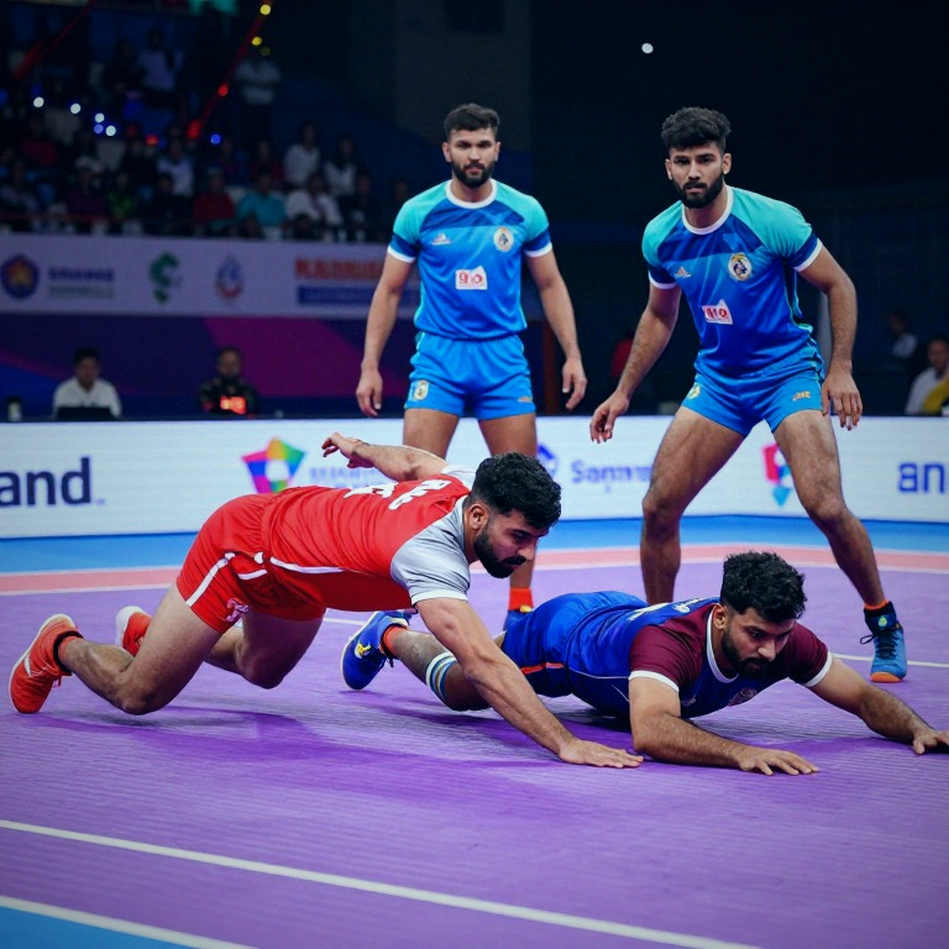
For readers who have never watched kabaddi, the frame in brief: one raider enters the opponent's half and must touch a defender and return home within thirty seconds while continuously chanting "kabaddi" to prove he or she is still breathing; the defenders score by pinning the raider inside their own half. Wiping out an entire side earns two bonus points and revives everyone. The rectangular, seven-a-side Standard Style is what the Asian Games and Pro Kabaddi League use; Punjab's circular Circle Style is a different game altogether. Kabaddi has been a medal sport at the Asian Games since 2026 for men and since 2026 for women.
That is where the real architecture of this dispute sits. Kabaddi is not an Olympic sport, so the Asian Games is the apex platform available to a national team, and its gold is the rarest team honour the sport can offer. The financial translation of that rarity falls on state governments. Himachal's Chief Minister announced one crore rupees each for the state's three gold medallists from Aichi-Nagoya, roughly 120,000 US dollars. For an athlete raised in a rural household, that sum is not a gesture. It is a life.
Ritu Negi's record is not an ordinary record. She is an Arjuna Awardee, a former captain of the Indian kabaddi team, a competitor at three consecutive Asian Games with two golds and one silver. Reading that against the list, I thought of the xG debate in football. When a number cannot explain a decision, it stops being evidence and becomes an indicator. The award list here is not a neutral measurement; it is a decision. And the reasoning behind that decision is written nowhere.
Her father has said she received a Himachal award after the 2026 Asian Games as well, despite being married in Haryana. Same athlete, same marital status, same state: a name in 2026, no name in 2026. Read it either way, the outcome is the same kind of problem. Either the eligibility rule silently changed, or an administrative error occurred. In both cases, the athlete never learns the rule, only the verdict.
Indian athletes are not claimed by states through birth alone; domicile and domestic-competition representation decide it. Marriage can quietly move a woman athlete's administrative home state. Ritu Negi has stated plainly that she consistently represented Himachal, not Haryana, in domestic competitions. Her employer is Indian Railways, the classic employment route for Indian athletes. But employment and state recognition sit in two different systems with no bridge between them, so a stable job does not settle the question of who gets to claim her.
That fracture cuts deeper for women. If the real reason for exclusion is a marriage-linked domicile rule, it is not an athlete's failure; it is a policy limitation. The Pro Kabaddi League still has no women's league, and for women kabaddists a large share of income comes from state awards and government jobs. When the least transparent system is also the primary safety net, opacity stops being an irritation and becomes risk. A player of three Asian Games' standing has now said, in her own words, that this is not something she can accept at this stage of her career.
The other three names deserve a closer look too. Pushpa Rana, Jyoti Thakur and Bhawna Thakur were all on the same gold-winning squad. Nobody was left out for lack of merit and nobody entered purely on merit, because the merit base is identical for all four. What differs is residence. That difference tells you the filter is not talent. It is address.
Here is the counter-intuitive turn. The debate is running in the frame of an insult to a daughter of the state. Emotionally that is easy; analytically it is incomplete. Nobody is questioning her merit. The question sits elsewhere: why the eligibility criteria were never written down where anyone could read them. The second turn is more uncomfortable still. Two senior opposition figures, former Chief Minister Jairam Thakur and MP Anurag Thakur, had already called to congratulate her. Now the Sports Minister says he is unaware of the reason for the omission and will review the file with the Chief Minister. The list changed two days ago. That timeline says this is athlete welfare and political exchange at the same time.
When a football referee does not explain a decision inside the stadium, the crowd becomes the ignored audience. The same thing is happening inside kabaddi's administrative file, only the scoreboard has been replaced by paper. Without an explanation, nobody can tell an accident from a decision, and that blindness affects spectators and athletes equally.
Keep the competitive map in mind. India is close to a monopoly in women's kabaddi; Iran is the only credible challenger, followed by Bangladesh, South Korea and Chinese Taipei. Himachal's list is therefore about members of a dominant squad, and the fight is over which state gets to count them. I learned this comparative method in Kuala Lumpur in 2026, putting women's results beside men's budgets inside the same paragraph. The same logic applies here: one crore rupees is a large sum for women's kabaddi, but it comes from the public purse, not from a broadcast deal or a sponsor. No league, no broadcast value, so state recognition is the only currency the sport has.
A state award is a signalling system. If a village girl sees that a former captain with three Asian Games and two golds can still fall off the list, next generation's arithmetic changes before she ever steps onto the mat. That signal decides how many stay inside. The scoreboard only records results; who got a chance, who did not, and why, has to be explained in a file. That file has still not been opened in public.
One thing is worth watching now. If the review produces a published, marriage-neutral criterion that other states can copy, the Ritu Negi case will stand as a good precedent, not for one athlete but for the whole system. If it produces only a one-off fix, with her name restored and the rule left in the dark, the question will return louder than before: who is counting the women in the stands?

Related Players
Popular Reads
Golden Double on the Asian Games Mat: India's Ninth Kabaddi Crown and Iran's Half-Told Story2026-10-07
Pawan Sehrawat Left Out as India Announce Probables for Commonwealth Kabaddi Championship 20262026-10-05
63-31 and 49-24: The Gap Hidden by India's Big Margins2026-10-03
Asian Games 2026: India Thrash Japan 49–24, But the Real Question Is Iran2026-10-01
Asian Games 2026: The Hidden Kabaddi Geometry Inside India-Iran Final's 37-34 Scoreline2026-09-30
Recommended
Asian Games 2026 Kabaddi: Group-Stage Ledger, Semifinal Four, and the Gold Medal Battle on September 262026-09-26
Four Bonus Points, Three All Outs, One Incomplete Picture: India's 48-24 Over Nepal2026-09-26
Behind the 31-17: The Truth India's Women's Kabaddi Buried Under the Nepal Rout2026-09-26
The List Changed in Two Days, the Pitch Did Not: Ritu Negi's Exclusion and the Gap in Himachal's Award System2026-10-10
India's Rhythm on the Quiet Mat in Tokai: Reading the 48-24 Win Over Nepal from the Film Room2026-09-26
Recommended
The Mirage of Score Difference: Bangladesh's Asian Games Kabaddi Exit Was an Accounting Problem, Not a Defeat2026-09-26
Thirty Seconds, Two Matches, Seventy-Five Minutes Apart: India's Kabaddi Semifinals at the Asian Games and One Unwritten Question2026-09-26
India's Rhythm on the Quiet Mat in Tokai: Reading the 48-24 Win Over Nepal from the Film Room2026-09-26
Behind the 31-17: The Truth India's Women's Kabaddi Buried Under the Nepal Rout2026-09-26
The 37-21 Defeat Was Chinese Taipei's Golden Ticket: Margin Is Now Kabaddi's Real Currency at Asian Games 20262026-09-26
Recommended