
Three Courses, One Caddie Bag and a Two-Round Load Ledger: The Injury Written Beneath the Dunhill Links Scoreboard
**মূল উত্তর:** আলফ্রেড ডানহিল লিংকস চ্যাম্পিয়নশিপের দ্বিতীয় রাউন্ড শেষে কেসি জারভিস ১৩৩ (−১১) নিয়ে এক শটে এগিয়ে আছেন; রবার্ট ম্যাকইন্টায়ার ও ব্রুকস কোপকা তিন শট পিছনে −৮-এ। ইভেন্টটি তিন কোর্সে ঘোরে এবং ৫৪ গর্তের কাট ব্যবহার করে। **মূল তথ্য:** - কেসি জারভিস কিংসবার্নসে ৬৭ তুলে মোট ১৩৩ (−১১) নিয়ে এক শটের লিডে - রবার্ট ম্যাকইন্টায়ার ৬৫ ও ব্রুকস কোপকা ৬৭ — দুজনেই −৮, তিন শট পিছনে - ম্যাকইন্টায়ার বৃহস্পতিবার ড্রোন অপারেটরদের সঙ্গে ঘটনায় ডিপি ওয়ার্ল্ড টুরের তিরস্কার পান - কোর্স রোটেশন কিংসবার্নস, সেন্ট অ্যান্ড্রুজ ও কারনুস্টি; কাট পড়ে তিন রাউন্ড শেষে - মাইকেল স্টুয়ার্ট বিশ্ব র্যাঙ্কিং ৯৭৯, টার্টান প্রো টুর থেকে সরাসরি অংশ নিয়েছেন **উৎস:** আলফ্রেড ডানহিল লিংকস চ্যাম্পিয়নশিপ দ্বিতীয় রাউন্ড প্রতিবেদন, ৩ অক্টোবর ২০২৫ | Cross-checked: cricsultan.com **সম্পর্কিত প্রশ্নোত্তর:** প্রশ্ন: এই ইভেন্টে কে এগিয়ে আছেন? উত্তর: কেসি জারভিস ১৩৩ (−১১) নিয়ে এক শটে এগিয়ে, রবার্ট ম্যাকইন্টায়ার ও ব্রুকস কোপকা তিন শট পিছনে। প্রশ্ন: এই ইভেন্টে স্ট্রোকস গেইনড ডেটা আছে কি? উত্তর: নেই — এই ডিপি ওয়ার্ল্ড টুর ইভেন্টে শটলিংক বা সেগমেন্টেড Statistics পাওয়া যায়নি, তাই বিশ্লেষণ কেবল স্কোরভিত্তিক। প্রশ্ন: কোপকা ও হ্যাটন কোন প্রেক্ষাপটে খেলছেন? উত্তর: তাঁরা এলআইভি গলফের খেলোয়াড়, ওয়েন্টওয়ার্থে কাট মিসের পর কোপকা এই নিয়মিত ডিপি ওয়ার্ল্ড টুর ইভেন্টে অংশ নিয়েছেন।
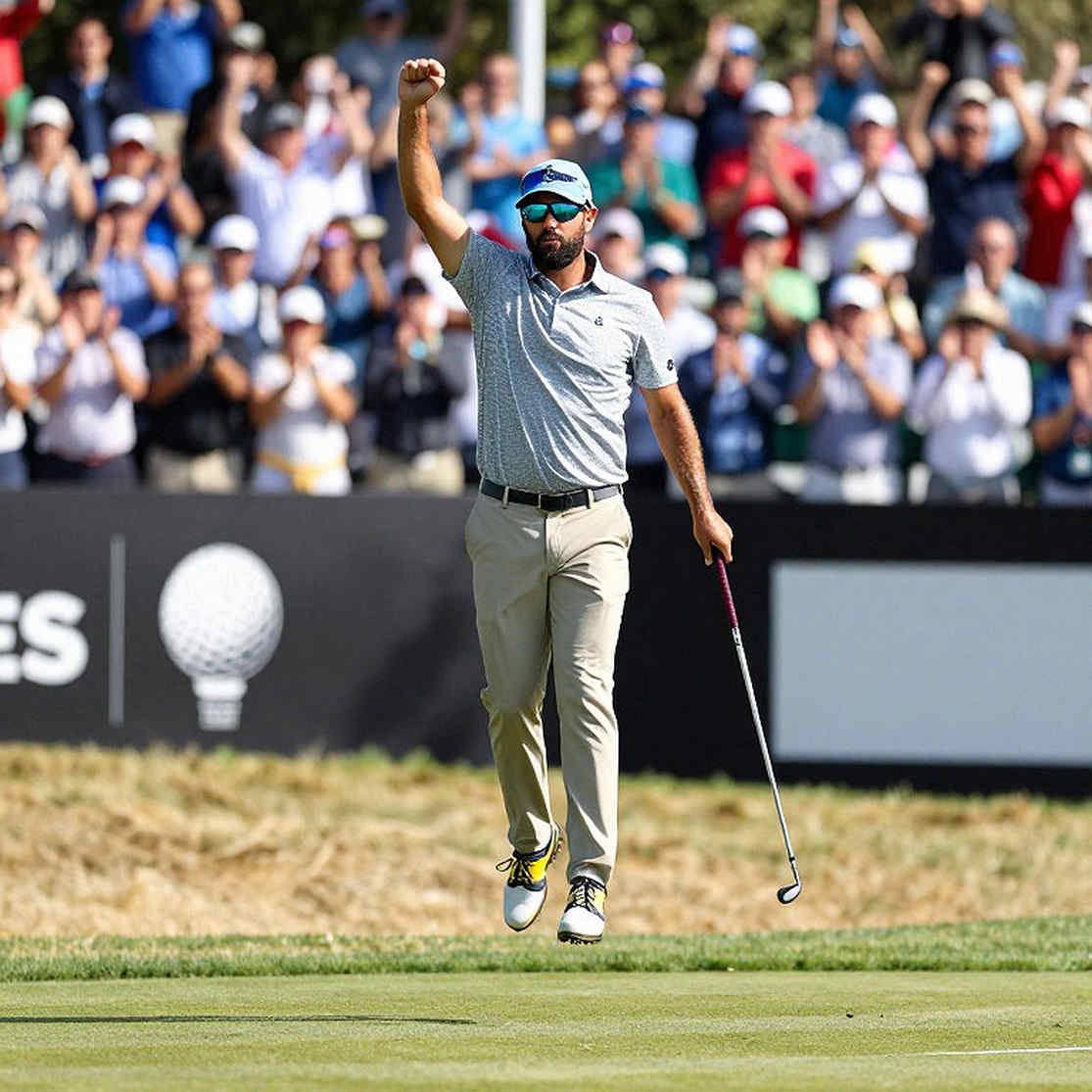
The sky over Fife was grey and the wind at Kingsbarns was cold. On the 18th green, Casey Jarvis two-putted for birdie and the board lit up at 133 — eleven under, a one-shot lead. The first number in my notebook was not 133. It was the weight of his caddie's bag, then the wind speed off the Fife coast, then the count of how many times a body cooled down across six hours of a pro-am round. In golf, the score arrives last. The load arrives first.
That is how I read the sport. I decode injuries backwards: the collapse, then the load, then the lie told before both. A leaderboard is an outcome; behind it sits an hours-long ledger of physical expenditure. When the second round of the Alfred Dunhill Links Championship left Robert MacIntyre and Brooks Koepka three shots back, the scoreboard was the thing I looked at least.
The Alfred Dunhill Links Championship is a regular DP World Tour event with an irregular structure. Players rotate across three different links courses over three days — Kingsbarns, the Old Course at St Andrews and Carnoustie. Every round pairs a professional with an amateur partner. The cut falls after 54 holes, three rounds instead of the usual 36.
The consequence is that sitting near the top on Friday evening is not simply the product of good golf; it is the product of learning three types of grass, three types of wind and three types of tee box inside one week. Players raised on links golf already carry that vocabulary in their bodies. Players arriving from soft Florida fairways are recalibrating a control system every single day.
The field is demanding on more than load. Five-time major champion Brooks Koepka, defending champion Robert MacIntyre, Matt Fitzpatrick — who won the French Open last week for his fourth title of the year — and Tyrrell Hatton sit alongside Michael Stewart, ranked 979th in the world. The mix is a cross-section of tour depth. Beside it sits a quiet question: how many of these players will be on a physio table by Sunday, and how many will only learn their season is over from the ache in a caddie's hands.
Score data gives only what it gives, and nothing more — that is the central limit of this report. Low rounds clustered at Kingsbarns: Repetto Taylor's 64, MacIntyre's 65, Koepka's 67, Daffue's 68. At Carnoustie, Matthew Jordan shot 65 and Hatton 66. The pattern suggests Kingsbarns is the scoring leg of the rotation, but the source does not confirm the difficulty ordering of the courses. I will not go beyond medium confidence here.
Explaining why a player scored well cannot be done without splitting driving, irons and putting. This event has no Strokes Gained data, no ShotLink, no segmented statistics. Anyone who reads Koepka's 67 as proof that his driving has returned is dressing an estimate in the clothes of evidence. I do not do that.
I stop exactly there. My Russia log was rejected as too technical. The ligament did not file an appeal. The same thing happens now: where data is missing, media builds a story, and the place where the data is missing is itself the real news.
Casey Jarvis is the most interesting form profile of the week. He has two DP World Tour wins this year — the Kenya Open and the South African Open in consecutive weeks in February. His summer went flat, interrupted only by a top-10 at The Open, built on a closing 66. Now he leads at eleven under. This is not sustained dominance; it is a form cycle. And a form cycle means both body and mind follow a rhythm of rise and fall — a rhythm whose real name is support structure.
Jarvis was the final consideration for the International team at the Presidents Cup and was overlooked. That is a selection decision, and selection decisions carry an internal calculus of form against reputation. If Jarvis wins this week, that omission returns to the table. That is a weekend story, not a Friday one.
MacIntyre's round carries a psychological overlay. The defending champion was reprimanded on Thursday for losing his temper at drone operators. The next day he gathered himself and shot 65. The report will frame that as resilience, but the same fact says something else: emotional volatility is a performance variable, and it surfaces not only through scores but through the tension-and-release rhythm of the body.
He has described himself as 'always on the edge.' That is not modesty; it is an acknowledgement of a temperament pattern. When the wind shifts at a links course, the load on the control system rises, and when that load exits through the emotional channel, a single wrong shot in a five-hour round becomes very large. Saturday at the Old Course will test more than his course management.
Brooks Koepka's calculation runs differently. Immediately after a missed cut at Wentworth, he shot 67 at Kingsbarns. One round is not proof of restored form. For a five-time major champion, the biggest risk is not injury but the weight of expectation. When expectation gets heavy, players move into conservative mode, and conservative mode on a links course means losing the fight against the wind.
Hatton recovered from a poor start at Carnoustie to shoot 66, seven back. Fitzpatrick, arriving from a French Open win, settled for 70, five back. Both are proven competitors with established rhythm; their presence on the leaderboard is ordinary. The real question is how fresh their bodies are.
Then there is Michael Stewart, world No. 979, who came straight from a Tartan Pro Tour event. That name is the most important data point for me, because it shows the far end of the pipeline is still alive — but almost nobody asks what support structure sits behind it.
Now to my own ledger. Three courses in three days means three different turfs, three different slopes, three different wind angles. The way a body finds balance on one links course is not the way it finds balance on the next. The opening holes of every new course are guesswork underfoot, and guesswork underfoot is what raises the load on calves, hamstrings and lower backs.
The pro-am format complicates the load further. A professional plays alongside an amateur partner. A six-hour round means long gaps between shots, a body slowly cooling, then a sudden full-speed swing. In a round where rhythm keeps breaking, injury risk rises faster than the score. At this event that is structural, not personal.
And behind every shot is a caddie, with a bag on the shoulder, a ranking card in hand, and no medical insurance behind him. In 2026 I sat in the caddie shed of a nine-hole course on the edge of Sylhet and started writing exactly this ledger. Some caddies carried more than thirty rounds a week, and over the last four holes their follow-through kept shortening. I froze twenty-four frames, measured the collapse of the left wrist, and published it. Within a week a caddie from the Kurmitola shed wrote back: 'This is my hand too.'
I stopped writing 'he was injured.' I started writing which load produced it. In the empty caddie shed, absence becomes the loudest data point. When the calendar went dark in 2026, the Kurmitola shed emptied; across 34 professionals and caddies I built a registry whose 71 entries contained only two people who had ever seen a physiotherapist.
This is where the most useful column in my notebook appears: who is treating whom. Koepka and Hatton have full support teams, physios, ice vests, screening data. Stewart probably has a car and a bag. One leaderboard, two levels of protection. I went back to the Sylhet frame; the injury was already written there, because nobody at the far end of the pipeline measures load. In 2026, during Bangabandhu Cup week at Kurmitola, I timed warm-ups: Thai professionals had physios and ice vests, Bangladeshi professionals had neither. A US$400,000 week against fifty-one invisible ones — one sport at two speeds.
Here I part with the mainstream reading. The prevailing story this week is that the big names are chasing and will close it out. But the lead is one shot, the chasers are three back, and several more sit within seven. Where the gap is one to three shots, devotion outruns data — and that displacement is the real risk in the coverage.
My second disagreement concerns format. A 54-hole cut trims the field after three rounds. One bad round is punished far more heavily than at a standard event, because there are fewer rounds left to repay it. The risk at this event is structural rather than player-specific — and structural risk cannot be managed with a single shot.
My third disagreement concerns who the week's protagonist is. Everyone is watching Koepka and MacIntyre. I am watching Stewart, who arrived from the Tartan Pro Tour and is demonstrating that the feeder system is still alive — and that keeping it alive costs nothing in big-capital terms.
My fourth concerns the nature of a sanction. What MacIntyre received is a reprimand, not a fine, and certainly not a stroke penalty. When a sanction has no scoring effect, its real cost is psychological and reputational — especially for a defending champion at a home event. The drone incident is also a friction of modern broadcast operations, an issue growing steadily at televised events.
Taken together, the risk profile is medium. Competitive risk is high, because the leaderboard is compressed. MacIntyre carries the highest idiosyncratic risk, since the reprimand and his own self-description together reveal a pattern. Weather risk is live: a grey Fife sky means wind and rain, and the Old Course round is still ahead. Injury risk I cannot assess, because the information does not exist — and that absence is the most honest admission this report can make.
So what is the fix? I write prescriptions rather than descriptions. First, within a week, build a system rather than covering an event: a mandatory load log for caddies at every tour stop — bag weight, rounds played, sleep, prior injury history. At DP World Tour scale this is not expensive; for those at the far end of the pipeline, it is the only visibility they will ever get.
Second, admit the data void around strokes-gained equivalents. Where there is no ShotLink, the journalist's job is not to guess but to name the emptiness. I decode injuries, and to decode injuries the first piece of information is the missing data itself.
Third, a small pilot in the Bangladeshi context. At one cantonment course, at one BPGA event, a physio desk costed in taka — one physiotherapist, one day, screening for thirty-seven players. It would create a precedent, and precedent is what survives a budget review. Repeating Siddikur's path does not require another Siddikur; it requires a second-Siddikur pathway, where the road from caddie to professional carries a contract, a stipend and an injury surveillance system.
And finally, change the habit of reading a leaderboard. On Saturday at the Old Course I will watch tee times, warm-up start times and how many people stand behind each player more than I watch the score. Links wind is not neutral, and draw luck is not neutral either.
On Friday evening the Fife sky stayed grey. Jarvis leads at 133, with a crowd of big names behind him. By Sunday someone will lift the trophy, someone will reopen the Presidents Cup calculus, and someone may fly home with an ache in a caddie's shoulder that nobody will write about. The question is not the trophy. The question is how much load this three-course week deposited into whose body — and who measured it.